Worthington MN Gutter Shutter Installation after New Metal Roof Install
Challenge
A homeowner contacted us to evaluate the performance of her existing LeafGuard gutter system after a recent roofing upgrade. The home originally had the LeafGuard system installed and functioning as intended. However, a new metal roof was installed directly over the existing asphalt shingles, resulting in a measurable change to the roofline height and drip‑edge position.
This case study outlines the technical implications of raising a roofline, how it affects gutter alignment and water capture, and the corrective measures required to restore proper system performance.
Solution
The LeafGuard system is designed to operate within specific dimensional tolerances. The hood, trough, and mounting brackets rely on the relationship between the gutter and the roof’s drip edge to ensure water transitions smoothly from the roof surface on to the gutter system.
When the original roof was in place, the system was installed at the correct height and pitch, allowing water to roll off the shingles and on to the gutter hood without overshooting.
The homeowner’s new metal roof was installed as an overlay; placed directly on top of the existing shingles rather than removing them. This installation method raised the roofline several inches.
Technical Challenge: Roofline Elevation
1. Change in Drip‑Edge Position
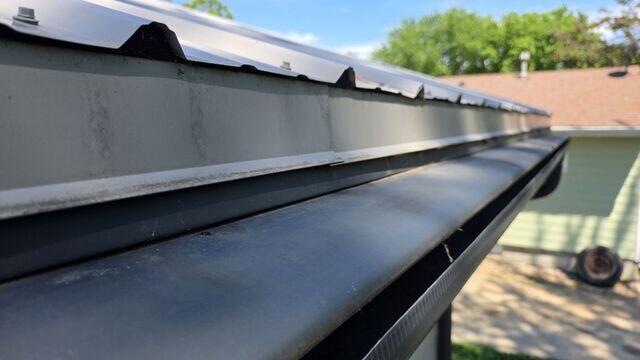
By installing the metal roof over the existing shingles, the drip edge was effectively lifted. This altered the geometry between the roof and the gutter system.
2. Gutter Height Discrepancy
Because the gutters remained in their original position, the raised roofline created a larger vertical gap between the roof edge and the gutter hood. Although the LeafGuard system was still sealed properly, preventing water from getting behind the gutters, the functional alignment was compromised.
3. Water Overshoot
Metal roofing sheds water at a higher velocity than asphalt shingles. Combined with the increased roof height, water began overshooting the gutter hood instead of entering the system. This resulted in:
-
Reduced water capture
-
Increased perimeter runoff
-
Potential erosion and foundation impact over time
Site Evaluation
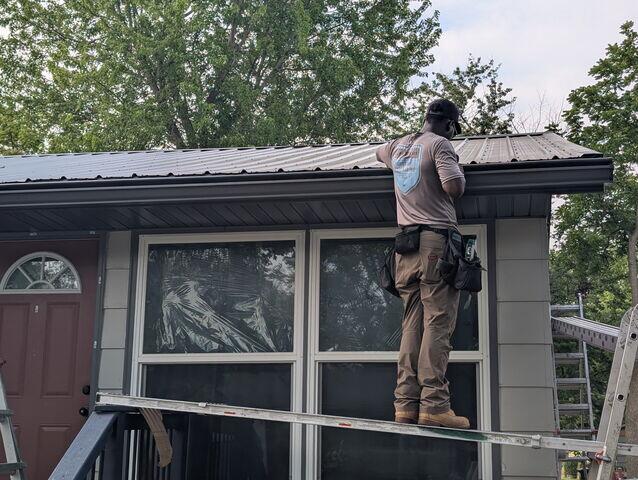
During our inspection, we assessed:
-
The new roof height relative to the original gutter installation
-
The angle and speed of water flow off the metal panels
-
The current bracket placement and structural integrity
-
The feasibility of repositioning or re‑mounting the existing system
Our evaluation confirmed that the gutter system itself was intact and functioning within its original specifications. The issue was strictly related to the change in roof geometry.
Recommended Corrective Measures
To restore proper water management, the gutter system must be repositioned to match the new roof height. This may include:
-
Raising the gutter system to re‑establish correct alignment with the drip edge
-
Adjusting bracket placement to maintain proper pitch
-
Ensuring the hood sits at the optimal distance from the metal roof panels
-
Verifying that water transitions smoothly into the gutter channel under high‑flow conditions
These adjustments will allow the system to perform as intended despite the roofline modification.
Conclusion
This project highlights a common but often overlooked issue: when a new roof is installed over an existing one, the resulting elevation change can significantly impact gutter performance. Even a high‑quality, fully sealed system like LeafGuard can become misaligned when the roof geometry changes.
By conducting a detailed technical evaluation, we identified the cause of the water overshoot and outlined the corrective steps needed to restore full functionality. Proper alignment between the roof and gutter system is essential for effective water management — especially on homes with metal roofing.